Why Asking for Reviews Doesn’t Work (And What Small Businesses Should Do Instead)
Many small businesses rely on a simple strategy to grow their Google reviews: ask the customer at the end of the job.
In theory it sounds reasonable. If the service went well, the customer should be happy to leave a review.
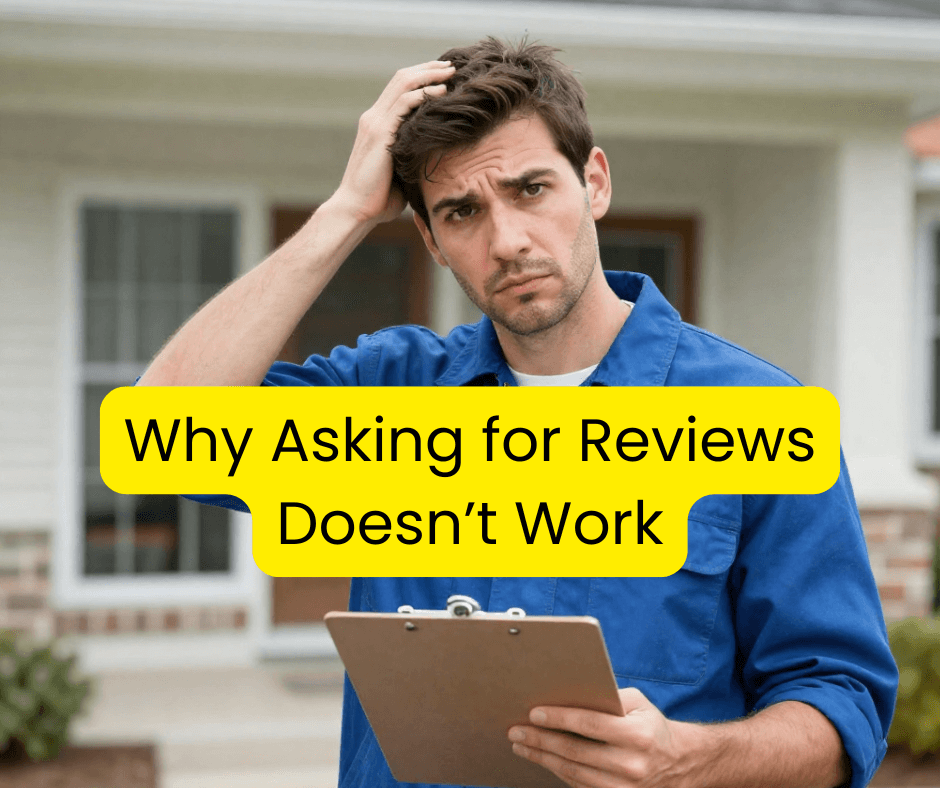
In practice, however, most businesses quickly discover why asking for reviews doesn’t work the way they expect. Reviews come in bursts, then stop. Staff forget to ask. Customers say they will do it later, but rarely follow through.
The issue is not motivation or customer satisfaction. The real issue is process.
Manual review requests depend on memory, timing, and individual effort. That combination is unreliable in almost every small business environment.
This article explains why asking for reviews doesn’t work, what typically goes wrong, and how businesses can replace manual requests with a simple, consistent system.
If you want the bigger picture on how review systems work, see our main guide:
The Complete Guide to Review Automation for Small Businesses (2025).
The Real Reason Why Asking for Reviews Doesn’t Work
Most business owners assume the main challenge is getting the courage to ask.
But that’s rarely the problem.
The real reason why asking for reviews doesn’t work comes down to four predictable issues:
- People forget
- Timing is poor
- The process is inconsistent
- Customers face too much friction
When these problems stack together, the result is slow or unreliable review growth.
Let’s break these down.
Problem 1: Humans Forget
Staff in small businesses are busy.
Whether you run a plumbing business, a dental clinic, or a cleaning service, the focus is usually on:
- finishing the job
- moving to the next appointment
- completing paperwork
- handling the next customer
Asking for a review is often the last thing on the list.
Even when the business owner encourages staff to ask consistently, reality tends to look like this:
Week 1: staff remember
Week 2: they remember sometimes
Week 3: the habit fades
This is one of the biggest reasons why asking for reviews doesn’t work over time.
Motivation fades. Systems don’t.
Problem 2: End-of-Day Asking Is Weak
Another reason why asking for reviews doesn’t work is timing.
Many businesses ask at the end of the job, usually when:
- the customer is leaving
- payment is being processed
- everyone is in a hurry
This is a weak moment to request a review.
Customers might say:
“Sure, I’ll do that tonight.”
But later that evening they are:
- busy
- distracted
- already thinking about something else
By the next day, the moment is gone.
The review never happens.
A better approach is to capture the request when the experience is still fresh and make the process extremely easy.
Problem 3: Manual Processes Create Inconsistency
Consistency is one of the key signals Google uses when evaluating review activity.
Businesses that grow reviews steadily often have:
- regular review frequency
- recent feedback
- ongoing activity
Businesses that rely on manual requests often show the opposite pattern:
- several reviews in one week
- then nothing for a month
- then another burst
This inconsistency is another reason why asking for reviews doesn’t work as a long-term strategy.
Google tends to reward steady review momentum, not occasional spikes.
If you want to understand how inconsistent review patterns affect rankings, you can also read our article on why Google reviews sometimes stall.
Problem 4: Too Much Friction for Customers
Even when customers are happy to leave a review, the process can be inconvenient.
Typical manual requests look like this:
“Would you mind leaving us a Google review?”
The customer then needs to:
- Search for the business on Google
- Find the correct listing
- Open the review box
- Write a review
Each step creates friction.
When people are busy, even small obstacles can stop them from completing the process.
This is another key reason why asking for reviews doesn’t work reliably.
A good system removes those steps entirely.
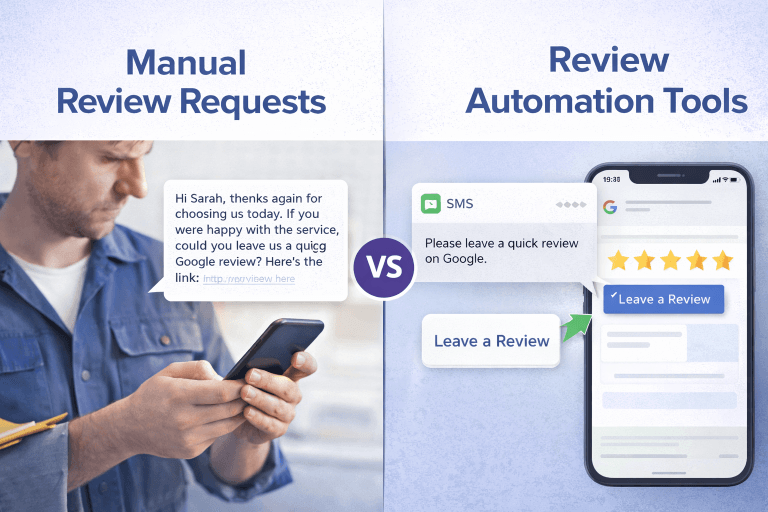
Example: Manual Review Requests vs Automated Requests
Let’s compare two common scenarios.
Scenario 1: Manual Asking
A landscaper finishes a job and says:
“If you have a moment later, please leave us a review.”
The customer agrees but forgets. Result: no review.
Scenario 2: Automated Request
After the job is completed, the customer receives a simple message:
“Thanks for choosing us today. If you have a moment, we’d appreciate your feedback.”
[Leave a review]
The link opens the review page directly.
Result: much higher chance of completion.
The difference is not persuasion. The difference is system design.
Why Systems Work Better Than Motivation
The most important lesson small businesses discover is this:
Systems outperform motivation.
Even excellent staff cannot maintain perfect habits indefinitely.
A review system removes the need for people to remember.
Instead, the process becomes:
- consistent
- predictable
- repeatable
That’s why businesses that implement even simple automation often see reviews increase naturally over time.
If you want to see an example of how a simple review system works, you can explore the DIY Google Review App used by many small businesses.
Checklist: Signs Your Review Process Needs Automation
You may need a review system if you notice any of these:
- Reviews arrive in bursts instead of consistently
- Staff forget to ask customers
- Customers say they will leave a review but rarely do
- Your competitors gain reviews faster than you
- You rely entirely on memory or verbal requests
These are all common indicators that manual review requests are breaking down.
If you want a quick overview of where your review process currently stands, you can also request a free review check.
Common Mistakes to Avoid
When businesses try to improve their review process, a few mistakes appear repeatedly.
1. Asking Only Happy Customers
This is known as review gating and can violate platform policies.
A better approach is to invite feedback consistently from real customers.
2. Waiting Too Long to Request Reviews
If too much time passes after the service, customers forget details of the experience.
Timely requests are much more effective.
3. Relying Only on Staff Memory
This is one of the core reasons why asking for reviews doesn’t work long-term.
Processes should support staff, not depend entirely on them.
How Review Automation Solves These Problems
A simple automation system typically does three things:
- Triggers the review request automatically
- Sends the customer a direct link to review
- Creates consistent review activity over time
This removes the four biggest weaknesses of manual review requests:
- forgetting
- poor timing
- inconsistent processes
- unnecessary friction
You can explore how this works in detail in our pillar article:
The Complete Guide to Review Automation for Small Businesses (2025).
When DIY Systems Make Sense
Some businesses prefer a simple tool they can manage themselves.
For example, the DIY Google Review App allows businesses to send structured review requests without needing complex software.
This approach works well for businesses that want:
- a straightforward process
- predictable review growth
- control over their review strategy
When Managed Reputation Services Help
Larger businesses or multi-location companies sometimes prefer a fully managed setup.
In these cases, a structured reputation management plan can ensure the process runs consistently without relying on staff habits.
Is Your Google Profile Losing Visibility?
If your Google reviews have slowed down or your profile isn’t appearing as often in search, the first step is understanding what’s actually happening.
I offer a one-time personalised audit showing:
• what’s limiting your ranking
• what Google is actually looking at
• what to fix first
Once you know where the gaps are, improving the process becomes much easier.
(Limited to 5 businesses per week)
Frequently Asked Questions
Why asking for reviews doesn’t work for many small businesses?
Manual requests depend on staff remembering to ask and customers following through later. In busy environments, this often leads to inconsistent or stalled review growth.
Do automated review requests violate Google rules?
No. Automated review requests are allowed when they simply invite genuine feedback from customers. What businesses must avoid is filtering or selectively requesting only positive reviews.
How many reviews should a business aim to get each month?
The exact number varies by industry and location, but steady activity is more important than large bursts. Consistent reviews over time tend to perform better for local visibility.
Do Google reviews affect local rankings?
Reviews are one of several factors that influence local visibility, along with relevance, distance, and overall profile activity.
What is the easiest way to request reviews?
The easiest method is providing customers with a direct review link through a simple message or system, reducing the steps required to leave feedback.