Why 5-Star Reviews Alone Don’t Increase Rankings
Most business owners assume that if they maintain a strong 5-star rating, their Google rankings will improve automatically.
It sounds logical. More praise equals more visibility.
But 5-star reviews alone don’t increase rankings.
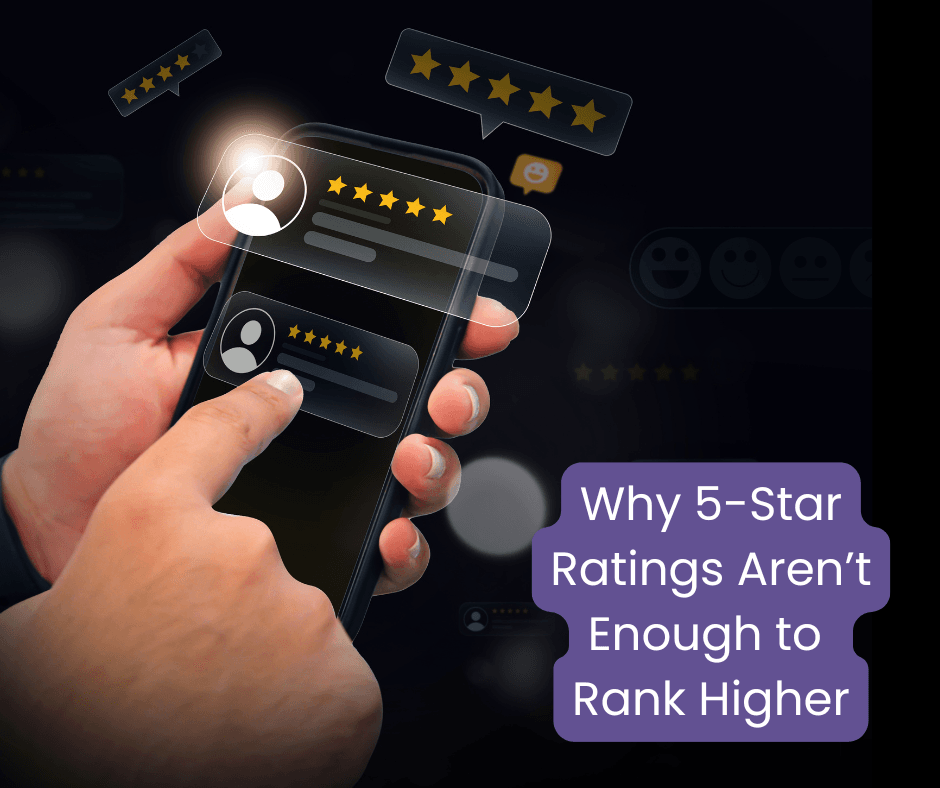
Google doesn’t reward perfection. It evaluates patterns. If your review strategy is built purely around maintaining a high average score, you may be missing the signals that actually influence visibility.
This article breaks down the myth — and explains what truly moves the needle in local search.
The Myth: “If I Keep a 5.0 Rating, I’ll Rank Higher”
The belief is simple:
High star rating = higher trust
Higher trust = higher ranking
While star ratings influence click-through behaviour, they are not the primary ranking driver.
A business with:
• 4.6 stars
• 95 reviews
• Consistent monthly activity
May outrank a business with:
• 5.0 stars
• 40 reviews
• No recent activity
That’s because 5-star reviews alone don’t increase rankings without supporting signals.
What Google Actually Measures
Google evaluates review signals over time. It looks at:
- Recency
- Frequency
- Velocity
- Keyword relevance
- Overall engagement
Star ratings are part of the picture — but not the deciding factor.
Recency Matters More Than Perfection
If your last review was 3 months ago, your 5.0 rating does not signal activity.
Google prefers businesses that appear active and consistently used.
Example:
Electrician A:
5.0 stars
Last review: 90 days ago
Electrician B:
4.7 stars
Last review: 5 days ago
Google is more likely to favour the business that appears currently active.
Recency outweighs static perfection.
Frequency Signals Operational Stability
Businesses that collect reviews steadily appear reliable.
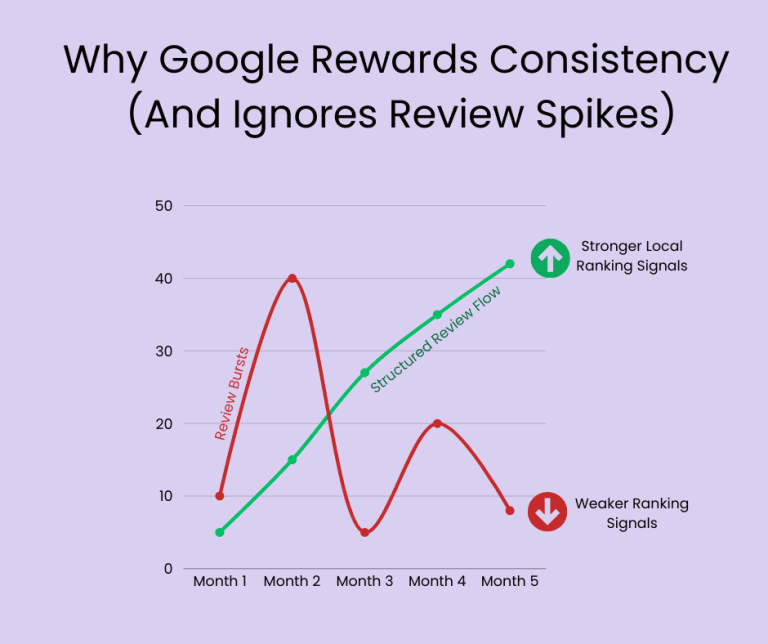
Businesses that receive 20 reviews in one burst — then nothing — appear inconsistent.
5-star reviews alone don’t increase rankings if they arrive irregularly.
Consistency creates momentum.
Momentum builds ranking strength.
Keywords in Reviews Carry Weight
Google reads review text.
A vague 5-star review:
“Excellent service!”
Provides minimal context.
A 4-star review that says:
“Emergency plumbing repair in Salisbury, fixed a burst pipe quickly.”
Reinforces:
• Service type
• Location relevance
• Search query alignment
That review may contribute more ranking relevance than a short 5-star comment.
Self-check: Are You Relying on Star Rating Alone?
Use this checklist:
✔ Have you had at least 2 reviews in the past 30 days?
✔ Do customers mention services or suburbs naturally?
✔ Are review requests built into workflow?
✔ Is your rating strong but your visibility flat?
✔ Are competitors with lower ratings outranking you?
If yes to two or more, you may be relying too heavily on average score.
Common Mistakes Businesses Make
Mistake 1: Avoiding All 4-Star Reviews
Some businesses panic over 4-star feedback.
But a healthy profile includes a mix.
A 4.6–4.9 rating with consistent activity often looks more natural and credible than a static 5.0.
Over-filtering can reduce momentum.
Mistake 2: Review “Campaigns” Instead of Systems
Running occasional pushes to maintain 5 stars does not build long-term ranking signals.
Structured review flow does.
If your review process depends on memory, visibility will fluctuate.
Mistake 3: Ignoring Review Text Strategy
Not scripting — guiding.
Encouraging customers to mention:
• The service provided
• The suburb
• The outcome
Strengthens relevance without manipulation.
The Difference Between Reputation and Ranking
Reputation:
Influences trust and click behaviour.
Ranking:
Influenced by behavioural patterns and activity signals.
You need both — but they are not the same lever.
5-star reviews alone don’t increase rankings because ranking systems evaluate trends, not perfection.
How to Shift From “Stars” to Strategy
Instead of focusing only on rating:
Focus on:
- Predictable monthly review flow
- Immediate post-job requests
- Light guidance for descriptive feedback
- Monitoring gaps in review activity
If you need a structured breakdown of execution steps, that’s covered in detail in 👉 How to Get More Google Reviews: The Complete No-BS Guide for Small Businesses (2025)
When to DIY vs Get Support
If you want to build your own structure through DIY tools, you should check out:
- Google Review Toolkit (with free preview)
- DIY Google Review App
If you want structured ongoing oversight:
Or if you simply want clarity on where to focus first, we offer a Free Review Check
The goal is not to inflate ratings.
It’s to build ranking signals that compound.
Frequently Asked Questions
Do 5-star reviews help rankings at all?
Yes — but mostly indirectly. They influence click-through and trust. They are not the sole ranking driver.
Is a 4.8 worse than a 5.0 for rankings?
Not necessarily. If the 4.8 profile has stronger recency and momentum, it may perform better.
Should I worry about a few 4-star reviews?
No. A natural review profile with steady activity is healthier than a static perfect score.
5-star reviews alone don’t increase rankings.
Recency does.
Frequency does.
Keywords do.
Momentum does.
If your visibility strategy begins and ends with protecting a 5.0 rating, you’re focusing on reputation instead of ranking.
Structured review flow builds both.