The Hidden Cost of Inconsistent Google Reviews (And How to Fix It)
If your business gets reviews in bursts — three one month, none for two months, then another spike — you are dealing with inconsistent Google reviews.
Most business owners assume this is normal. They believe reviews depend on luck, customer mood, or how busy the team is.
But inconsistent Google reviews are not random.
They are a system problem — and they quietly affect your visibility, credibility, and revenue.
This article breaks down what inconsistent review patterns actually cost you, why Google cares about consistency, and how to fix it without complicated software or marketing tricks.
Why Inconsistent Google Reviews Hurt More Than You Think
Many local businesses focus on total review count.
They’ll say:
“We have 87 reviews. That’s pretty good.”
What they don’t notice is that their competitor has 52 reviews — but gained 10 in the last 30 days.
Google does not just look at totals.
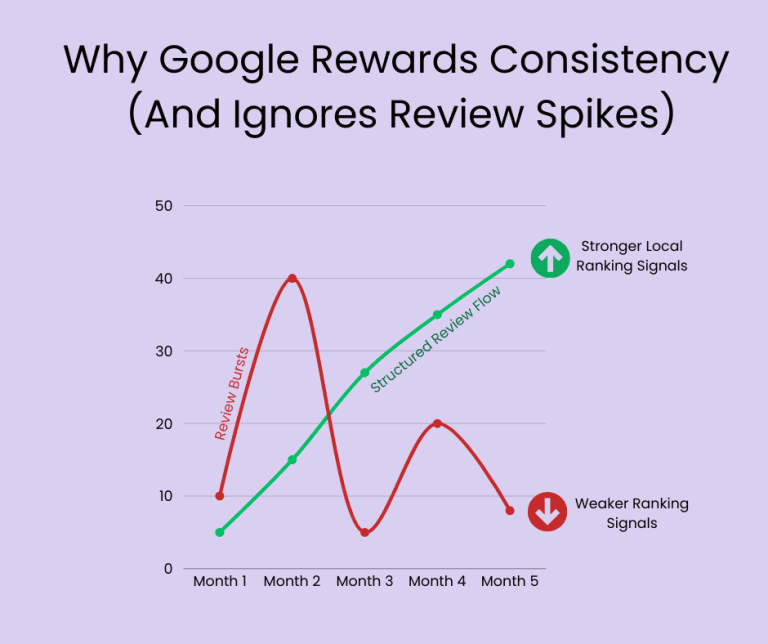
It looks at review velocity — the speed and consistency of new reviews over time.
When your review flow stops, momentum slows.
When momentum slows, rankings often soften.
This is covered in more depth in our main guide: How to Get More Google Reviews: The Complete No-BS Guide for Small Businesses (2025), but the key point is simple:
Google rewards businesses that appear active, trusted, and consistently chosen.
Inconsistent Google reviews signal the opposite.
What Causes Inconsistent Google Reviews?
In almost every case, the issue is not customer satisfaction.
It is process.
Here are three common causes:
1. Asking Only When You Remember
Many teams ask for reviews when:
- The job went perfectly
- The customer seemed happy
- Someone in the office remembered
That means reviews depend on memory, not structure.
Result: inconsistent Google reviews.
2. Relying on Verbal Requests Only
“Hey mate, if you get a chance, leave us a review.”
Even happy customers forget.
Without a follow-up system (SMS or email), most verbal requests disappear.
3. Seasonal Work Patterns
Trades and service businesses often have busy and quiet periods.
If you only ask during busy weeks, your review graph will spike and then flatline.
Google sees that stop-start pattern.
Customers do too.
The Financial Cost of Inconsistent Google Reviews
Let’s be direct.
Inconsistent Google reviews cost you in three ways:
1. Lower Local Map Visibility
When review momentum slows:
- Competitors with fresh reviews gain visibility
- Your map ranking can soften
- Click-through rates drop
Even small ranking shifts can mean fewer calls per week.
2. Reduced Customer Trust
Customers look at:
- Total stars
- Recent review dates
If your last review is three months old, the subconscious message is:
“Is this business still active?”
Fresh reviews reassure buyers.
Gaps create hesitation.
3. Missed Compounding Effect
Review growth works like momentum.
If you get:
- 1–2 reviews every week consistently
You build steady authority.
If you get:
- 10 reviews in one week, then none for 8 weeks
You create peaks and stagnation.
Consistency compounds. Spikes don’t.
Practical Example: Two Plumbers
Plumber A | Plumber B |
120 reviews | 75 reviews |
Last 6 weeks: 0 new reviews | Last 6 weeks: 9 new reviews |
Plumber B often outranks Plumber A.
Why?
Because recent activity signals relevance.
This is why inconsistent Google reviews quietly reduce competitive position over time.
Checklist: Is Your Review System Broken?
If you answer “yes” to any of these, you likely have inconsistent Google reviews:
- We don’t ask every customer.
- Asking depends on who finishes the job.
- There is no follow-up message.
- We don’t track how many review requests go out.
- Reviews come in bursts.
This is not a marketing issue.
It is a workflow issue.
How to Fix Inconsistent Google Reviews (Without Overcomplicating It)
You do not need a large CRM.
You need structure.
Step 1: Make It Automatic
Every completed job triggers:
- SMS
- Or email
- Within 24 hours
No exceptions.
Step 2: Make It Simple for Customers
Direct link.
One click.
Clear message.
Avoid long instructions or multiple steps.
Step 3: Track the Process
Even a simple spreadsheet works.
Track:
- Jobs completed
- Review requests sent
- Reviews received
If you don’t track it, it will drift.
Mistakes to Avoid
When fixing inconsistent Google reviews, avoid:
1. Incentives for reviews
This can breach Google guidelines.
2. Only asking happy customers
This creates artificial spikes and inconsistent patterns.
3. Waiting until the end of the week to send requests
Delay reduces response rates.
Consistency beats intensity.
When DIY Isn’t Enough
If your review flow has already stalled, you may need a structured system.
Miss K Local offers:
- A step-by-step Google Review Toolkit (with free preview)
- A simple DIY Google Review App for automated SMS follow-ups
- A one-off $97 Google Reviews Setup & Advice session
- Ongoing Reputation Management Plans
Or start with a no-pressure Free Review Check to see where you stand.
Frequently asked questions
How often should I get new Google reviews?
There is no fixed number, but consistent weekly activity is stronger than monthly spikes. Even 1–2 steady reviews per week builds momentum.
Do old reviews still matter?
Yes. Total reviews and rating matter. But Google also values recency and consistency.
Can inconsistent Google reviews affect ranking quickly?
Not overnight. But over weeks and months, inconsistent review velocity can gradually weaken visibility compared to active competitors.
Final Thought
Inconsistent Google reviews are rarely about customer happiness.
They are about systems.
When review flow stops, visibility slows.
When visibility slows, enquiries drop.
The good news?
This is predictable. And predictable problems can be fixed.
Build a system once. Let it run consistently.
Momentum will follow.