How Google Uses Reviews to Rank Local Businesses
Most business owners know reviews matter. What they don’t understand is how Google uses reviews to rank local businesses — and why simply collecting 5-star ratings isn’t enough.
If you’ve ever wondered why a competitor with fewer reviews appears above you in Google Maps, the answer usually isn’t the star rating. It’s the pattern behind the reviews.
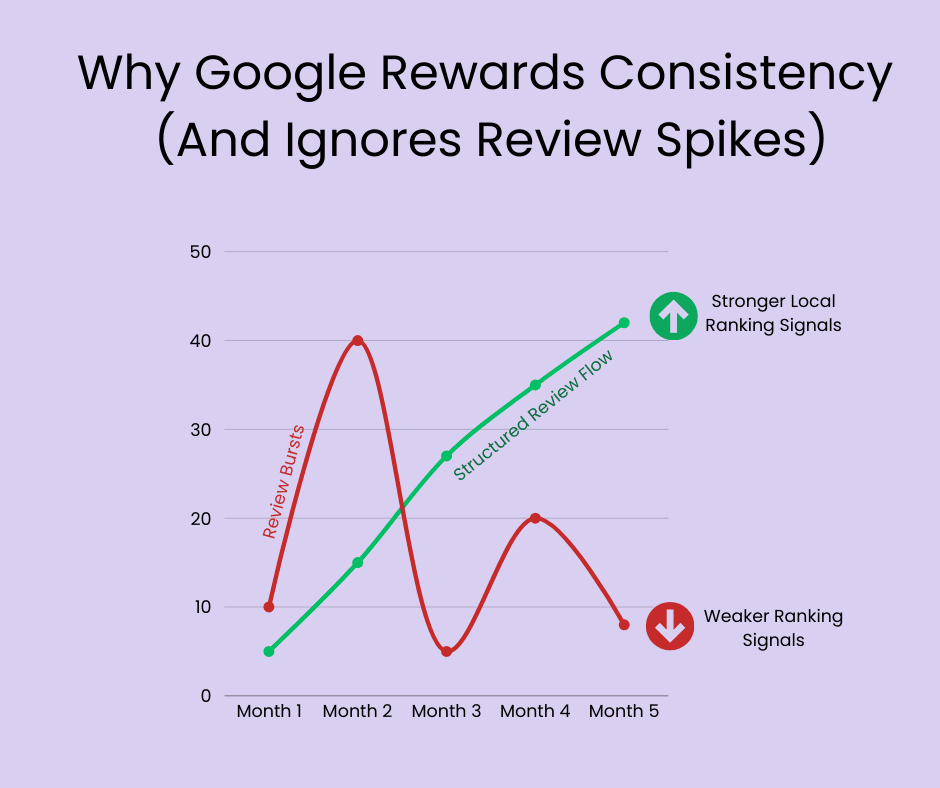
Google evaluates review signals over time. It looks at recency, frequency, keywords, and velocity. In other words, it measures behavioural trends — not just totals.
This article breaks down exactly how that works, in plain English.
The Big Myth: “More 5-Star Reviews = Higher Rankings”
This is the most common misunderstanding.
Yes, star ratings matter for click-through rates. A 4.9 looks better than a 3.8.
But rankings are influenced by patterns, not just averages.
Google wants to surface businesses that appear:
- Active
- Consistently serving customers
- Relevant to local searches
- Stable over time
That’s why understanding how Google uses reviews to rank local businesses requires looking beyond the star score.
The Four Review Signals Google Evaluates
1. Recency (How Recent Your Reviews Are)
If your last review was 4 months ago, that’s a signal.
Google interprets recent activity as:
- Ongoing customer flow
- Operational stability
- Continued relevance
A business that gets 3 reviews this month looks more active than one that got 25 last year and nothing since.
Example:
- Plumber A: 120 reviews, last one 5 months ago
- Plumber B: 80 reviews, 4 reviews this month
Plumber B may outrank due to recency and momentum.
Recency is one of the clearest indicators in how Google uses reviews to rank local businesses.
2. Frequency (How Often Reviews Come In)
Google doesn’t just check if reviews exist. It looks at how consistently they arrive.
If your reviews look like this:
- 12 in January
- 0 February–June
That signals a spike.
If they look like this:
- 3 in Jan
- 2 in Feb
- 4 in Mar
- 3 in Apr
That signals operational flow.
Google prefers the second pattern.
This is where many small businesses fall short. They “push for reviews” in bursts instead of building structured review flow.
3. Keywords in Review Text
Google reads review content.
If a customer writes:
“Great service!”
That’s positive — but vague.
If they write:
“Installed a new hot water system in Salisbury Heights and explained everything clearly.”
That review reinforces:
- Service type
- Location
- Relevance to search queries
Keywords inside reviews strengthen topical authority. They connect your profile to real search phrases.
This is a major factor in how Google uses reviews to rank local businesses — and one most owners overlook.
4. Velocity (Momentum Over Time)
Velocity combines recency and frequency.
It measures growth patterns.
A steady upward flow of reviews signals:
- Customer satisfaction
- Business momentum
- Ongoing trust
Momentum beats volume.
Google’s systems are built to reward stability over spikes.
What Google Is Actually Looking For
When you zoom out, Google wants confidence signals.
Reviews help answer:
- Is this business active?
- Do customers mention relevant services?
- Is it consistently used?
- Is it trusted locally?
Google Maps rankings are not emotional. They’re behavioural.
If you understand how Google uses reviews to rank local businesses, you stop chasing praise — and start building patterns.
Common Mistakes That Hurt Rankings
Mistake 1: Review Campaign Bursts
Running a “review push” twice a year.
Result:
Spikes followed by silence.
Better approach:
Build review requests into workflow so they happen weekly.
Mistake 2: Asking Without Guidance
“Please leave us a review.”
That’s too vague.
Customers don’t know what to write. So they leave 5 words.
Instead, gently guide them:
- Mention the service
- Mention the suburb
- Mention what stood out
Not scripting. Just structuring.
Mistake 3: Ignoring Review Gaps
If you haven’t had a review in 60+ days, that’s a ranking issue.
Many businesses don’t notice until traffic drops.
Practical Review Flow Checklist
Use this as a quick audit:
✔ Have you received at least 2–4 reviews in the past 30 days?
✔ Do reviews mention services or suburbs naturally?
✔ Is your last review less than 30 days old?
✔ Are requests part of your daily workflow?
✔ Are you relying on memory instead of a system?
If you answered “no” to more than two of these, you likely don’t have structured review flow.
What Structured Review Flow Actually Means
It doesn’t mean begging for reviews.
It means:
- Every completed job triggers a request
- Requests are sent immediately
- The process is simple
- Customers are guided naturally
- Momentum becomes predictable
If you want a deeper breakdown of practical tactics, the full step-by-step strategy is covered in How to Get More Google Reviews: The Complete No-BS Guide for Small Businesses (2025)
When DIY Makes Sense (And When It Doesn’t)
If you’re just starting, you can build your own review flow.
Tools that may help:
- Our Google Review Toolkit (with free preview)
- The DIY Google Review App for simple on-site capture
If you’re already busy and losing momentum due to inconsistency, a managed system may be better:
Or if you simply want clarity:
- $97 Google Reviews Setup Advice – for a in depth analysis, or
- Free Review Check – to help you focus on where you need to look first.
The right option depends on your time and structure.
FAQ – How Google Uses Reviews to Rank Local Businesses
Do star ratings matter for rankings?
Yes, but not in isolation. Extremely low ratings can impact trust and click-through, but ranking is more influenced by patterns like recency and velocity.
How many reviews per month should I aim for?
For most small local businesses, 2–4 per month consistently is more powerful than 15 in one burst.
Does replying to reviews help rankings?
Responding shows engagement and professionalism. While not a primary ranking factor, it reinforces activity signals and builds trust.
Understanding how Google uses reviews to rank local businesses changes everything.
You stop chasing totals.
You start building patterns.
Google rewards:
- Recency
- Frequency
- Keywords
- Momentum
If your review strategy is random, your visibility will be too.
Structured review flow turns reviews into a ranking asset — not just social proof.