Top 5 Local SEO Mistakes Small Businesses Make (And How to Fix Them)
If you’ve ever thought “why local SEO doesn’t work for my business?” — you’re not alone.
Most small businesses aren’t failing at local SEO because they didn’t try. They’re failing because of a handful of common local SEO mistakes that hold everything back. These mistakes don’t usually break anything outright — they just stop Google from trusting or prioritising your business.
This article breaks down the five of the local SEO mistakes small businesses make, explains why they matter, and shows you what to fix — without jargon, fluff, or vague advice.
(For the full system and long-term strategy, this post supports our pillar guide: The Complete Guide to Local SEO for Small Businesses (2025).)
Mistake #1: Treating Google Business Profile as “Set and Forget”
One of the most common local SEO mistakes is assuming that once your Google Business Profile (GBP) is claimed and filled out, the job is done.
It’s not.
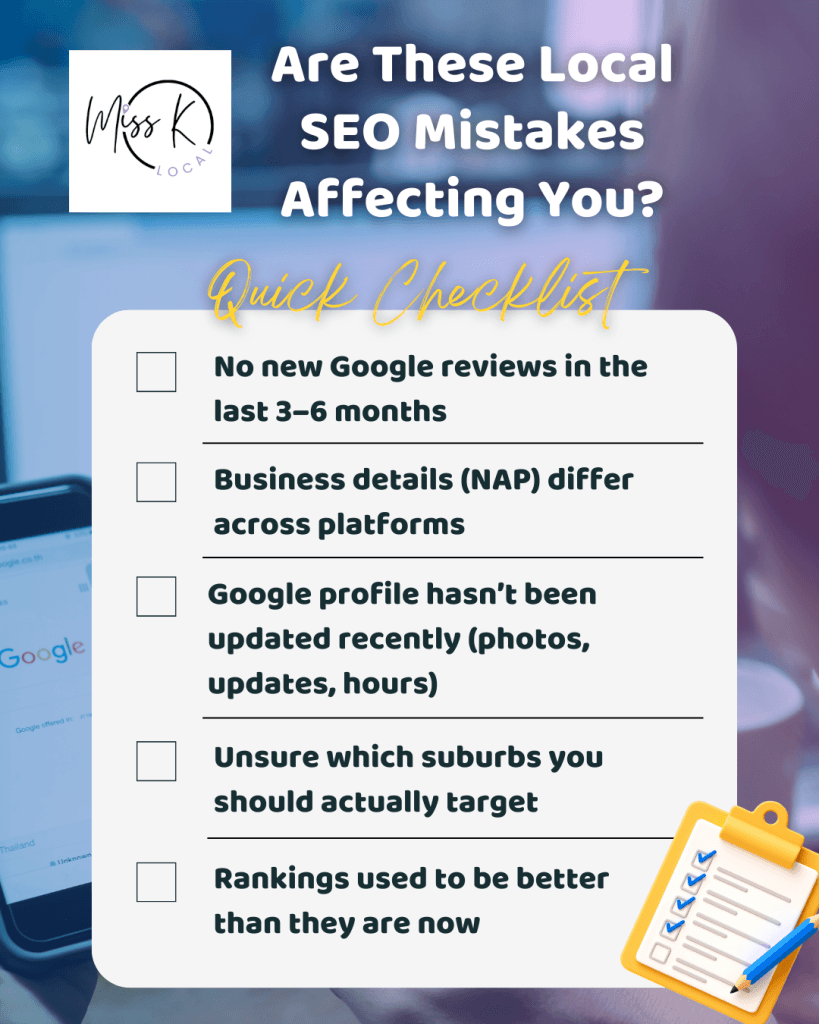
Google treats your profile like a living signal, not a static listing. Profiles that don’t change, don’t get reviews, or don’t receive updates slowly lose visibility.
Why this causes local SEO problems
- Google favours fresh activity
- Inactive profiles are less likely to appear in the Map Pack
- Customers trust profiles that look maintained
What to fix
- Post occasional updates (even once a month helps)
- Respond to reviews (yes, even old ones)
- Add new photos over time, not all at once
You can see a practical breakdown in the free guide 👉 Google Maps Ranking Playbook
Mistake #2: Inconsistent Business Details Across the Web
The NAP is one of the most invisible — but damaging — local SEO mistakes small businesses make.
If your:
- Business name (N)
- Address (A)
- Phone number (P)

…don’t match exactly across your website, Google profile, and directories, Google gets mixed signals.
Why local SEO doesn’t work when this happens
Google relies on consistency to confirm legitimacy. Conflicting details create doubt, which reduces ranking confidence.
Common examples
- Old phone number still listed on Yellow Pages
- “Suite” vs “Unit” in the address used inconsistently
- Trading name differs slightly between platforms
Quick checklist
- Check your GBP, website footer, and Contact page
- Google your business name + suburb
- Fix obvious mismatches first — perfection comes later
Mistake #3: Ignoring Reviews Until There’s a Problem
Reviews are one of the strongest local ranking signals — yet many businesses only think about them when a bad one appears.
This reactive approach creates ongoing local SEO problems.
Why this hurts visibility
- Google expects a steady review pattern
- Long gaps between reviews signal inactivity
- One negative review stands out more when there are few recent positives
What works better
- Make reviews part of your normal process
- Ask at the right moment (after a job, not weeks later)
- Make it really easy for customer to give you a review with links and reminders — don’t rely on customers “figuring it out”
If you want a DIY way to fix this properly, the Review Booster Toolkit give you a DIY guide, while the DIY Google Review App helps businesses to automate their review process.
Or, if you’d rather not touch it at all, Miss K Local also offers done-for-you reputation management plans.
Mistake #4: Targeting the Wrong Locations (or Too Many)
Another major reason why local SEO doesn’t work is unclear location targeting.
Many businesses either:
- Target too many suburbs at once
- Or only optimise for their office address, even if they service wider areas
Why this causes local SEO mistakes
Google needs clarity. Vague service areas = weak relevance.
Practical example
A plumber based in Salisbury but servicing surrounding suburbs like Golden Grove, Mawson Lakes and Para Hills, needs to have those locations reflected consistently across:
- GBP service areas
- Website content
- Supporting signals (reviews, mentions)
Trying to rank everywhere usually means ranking nowhere.
Mistake #5: Expecting Results Without Ongoing Signals
Local SEO is not a one-off task. It’s a system of small, ongoing signals.
This mistake often shows up as:
- “We did SEO last year”
- “The website is optimised”
- “Nothing’s changed, so why did rankings drop?”
The reality
Google rewards Consistency, Activity, and Trust over time.
A static profile doesn’t look trustworthy — even if it was once optimised perfectly.
If you’re unsure what actually matters for your specific business vs what’s noise, the Google Reviews Setup Advice ($97 one-off) walks through your profile to advise what is working and what needs improving – without upsells or contracts.
Frequently Asked Questions
Why does local SEO work for some businesses but not others?
Because the businesses seeing results usually avoid these core local SEO mistakes and maintain consistent signals over time.
How long does it take to fix local SEO problems?
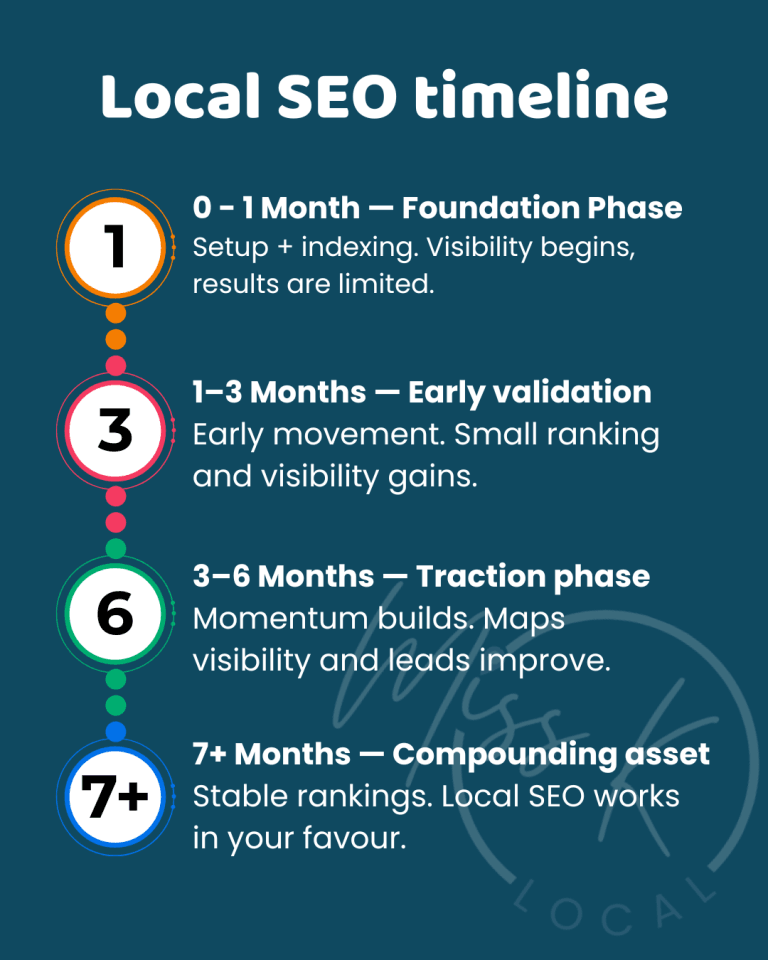
Some fixes (like NAP consistency) can help within weeks. Others, like reviews and trust signals, build gradually over months.
Do I need ongoing SEO services for local SEO?
Not always. Some businesses prefer DIY systems, others want it handled. What matters is that something continues — not that it’s expensive.
Where This Fits in the Bigger Picture
This article covers common local SEO mistakes and how to spot them. For the full system — including setup, priorities, and long-term strategy — see the guide:
👉 The Complete Guide to Local SEO for Small Businesses (2025)
If you want help choosing between DIY, one-off advice, or done-for-you support, Miss K Local focuses specifically on practical local visibility for small businesses — without lock-in contracts or hype.