The Complete Guide to Local SEO for Small Businesses (2025)
Local SEO for small businesses has changed massively over the past two years — and it’s still changing fast. If you run a local service business, trade, clinic, café, or mobile operation, your visibility on Google Maps is now one of the biggest predictors of whether you grow… or disappear behind competitors.
That’s why local SEO for small businesses is no longer “a nice-to-have.” It is one of the highest-ROI marketing activities you can do in 2025 — and the good news is that most of it is surprisingly simple once you understand what Google wants.
This guide breaks down everything you need to know to start improving your Google visibility, appear in more local searches, get more calls, and build a strong online footprint without expensive agencies.
What Local SEO Actually Means in 2025
Local SEO for small businesses is the practice of helping your business appear in Google searches made by people near you. There are two places you must show up:
1. Google Search (“organic results”)
These appear under the ads and above the footer. Keywords here include:
- “electrician near me”
- “best dentist in Adelaide”
- “landscaper Salisbury Heights”
2. Google Maps (“local pack results”)
These appear in the 3-pack or full map listings. This is where almost all the calls happen.
Google Maps visibility is determined by:
- your proximity to the searcher
- your Google Business Profile optimisation
- your reviews and reputation
- your local content & website signals
- your consistency across the web
Local SEO for small businesses blends all of these into one system.
Why Local SEO Matters More Than Ever
Here’s what we know from recent studies:
- 76% of people who search for a local service call or visit a business within 24 hours.
- 82% of customers read Google reviews first, before price or website.
- The businesses ranking in the top 3 on Google Maps get 60–75% of all local enquiries.
- Most small businesses are still not properly optimised — which means huge opportunity.
Local SEO for small businesses isn’t about tricking Google. It’s about sending the right signals so Google confidently recommends you to local customers.
The Core Components of Local SEO (What Actually Moves the Needle)
These are the core areas we focus on for Miss K Local clients — and what you can start improving today.
A. Google Business Profile (GBP) Optimisation
This is the #1 driver of Google Maps rankings.
Key areas to fix:
- Correct primary + secondary categories
- Accurate service areas
- Complete business info
- Keyword-rich service descriptions
- Consistent weekly updates
- High-quality photos
- Review growth system
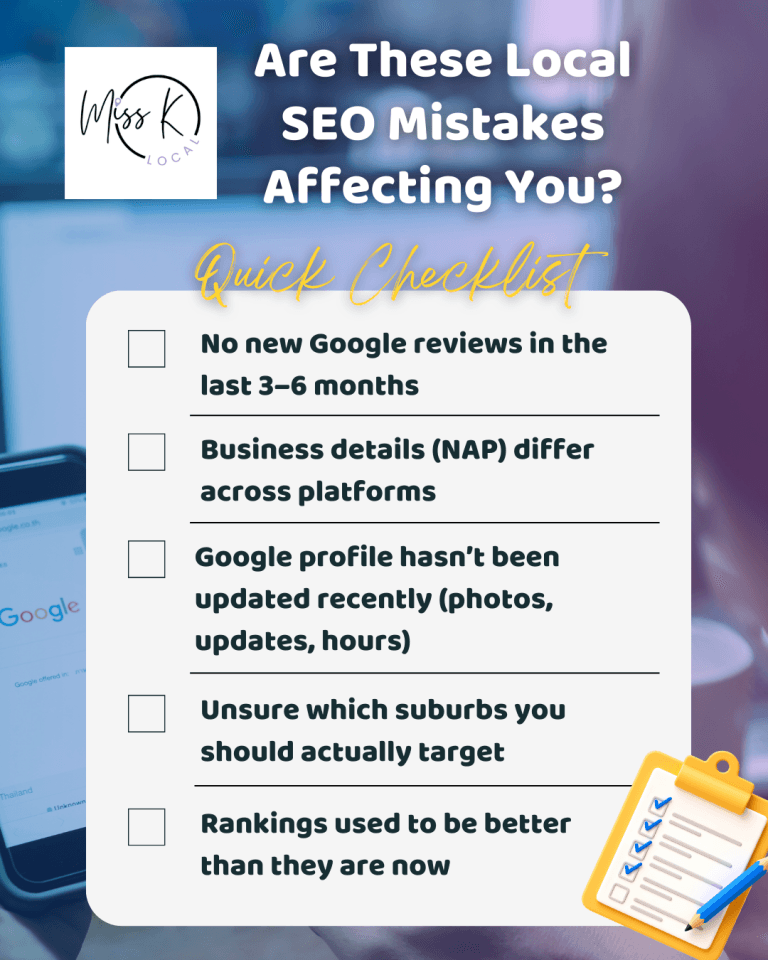
Most small business owners set up their GBP once and never touch it again — which means their rankings slowly collapse.
Local SEO for small businesses ALWAYS starts here.
B. Review Growth and Reputation Signals
Google now heavily weights:
- review volume
- review frequency
- review diversity
- review keywords
- review sentiment
If you haven’t had a review in 3–6+ months, Google sees your business as “inactive.”
A simple review system can change your ranking faster than almost anything else.
C. Website Local SEO Signals
If you have a website (even a simple one), it should include:
- suburb-based service pages
- keyword-rich headings
- clear service descriptions
- schema markup (local business schema)
- fast load speed
- mobile-friendly design
Your website reinforces your Google Business Profile — they work together.
D. Local Citations & Directory Listings
These are mentions of your business across the web.
Examples:
- Yellow Pages
- TrueLocal
- HiPages
- Local business chambers
- Industry associations
Consistent NAP (Name, Address, Phone Number) signals help Google confirm your legitimacy.
E. Content That Targets Local Searchers
This is one of the most underused opportunities.
Local content examples:
- “How to choose a plumber in Adelaide”
- “Best time of year for lawn renovations in SA”
- “What to expect at your first physio appointment”
Content gives Google context that you’re an active, trustworthy business.
You can also explore more detail on what matters for local SEO in the article Top 5 Local SEO Mistakes Small Businesses Make (And How to Fix Them)
The Exact Steps to Improve Local SEO for Small Businesses (DIY Roadmap)
Here’s the full, simple checklist you can follow today:
Step 1: Fix Your Google Business Profile
- Choose the correct categories
- Add your service areas (max 20)
- Write keyword-rich service descriptions
- Upload 10–20 high-quality photos
- Add opening hours & contact info
- Turn on messaging
- Complete the “From the Business” section
This is the heart of local SEO for small businesses — if your GBP is weak, nothing else fixes it.
Step 2: Set Up a Review System
You only need three things:
- A simple Google review link
- A message / script
- Reminders or automation
Aim for:
- 1–2 reviews per month minimum
- Reviews spread across the year
- Asking at the right time (job completion, purchase, checkout, etc.)
Reviews = ranking + trust + conversions.
Step 3: Improve Your Website’s Local Signals
Focus on:
- A clear “Service Areas” page
- One page per suburb (optional but powerful)
- Service pages with headings like “Plumbing Services in Adelaide”
- Adding your Google Maps embed
- Using your full business name, address, and phone number
Every change here strengthens your Google presence.
Step 4: Build Citations
Submit your business to at least 10 reputable directories.
Most small businesses are missing half of these — easy win.
Step 5: Post Weekly Updates on Google
Examples:
- job photos
- before/after photos
- quick tips
- seasonal reminders
- business updates
Weekly updates == activity signals.
Activity signals == higher rankings.
Step 6: Track and Test
Use a grid ranking tool or manual checks to track suburb performance.
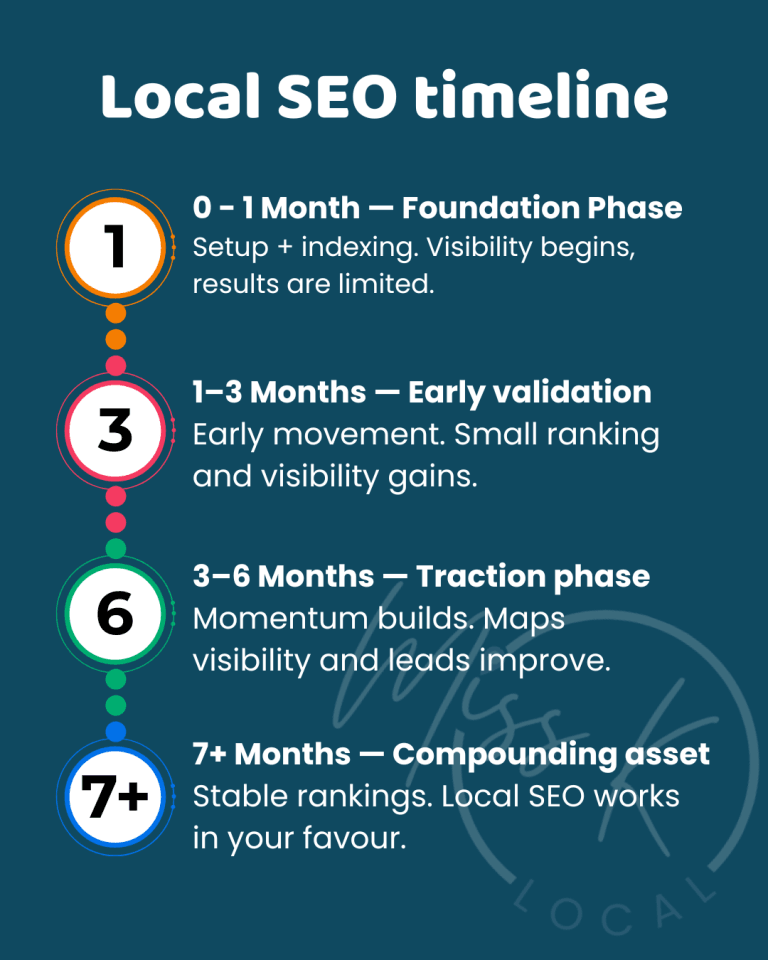
Local SEO for small businesses is a 60–90 day game — not a 24hr fix — but results compound fast.
What NOT to Do (Google’s Rules Matter)
Google has strict rules around reviews and local SEO.
Avoid:
- incentivising reviews
- only sending review links to happy customers
- generating fake reviews
- stuffing keywords unnaturally
- using inconsistent business information
Breaking these rules can lead to:
- review removal
- listing suspension
- ranking drops
See the official guidelines here: 🔗 https://support.google.com/business/answer/3474122
Local SEO for small businesses works best when you play by the rules — and simply show Google you’re a real, helpful, active business.
How Long Does It Take to See Results?
Typical 2025 timeline:
- 7–14 days → More impressions, discovery searches
- 30 days → More keywords ranking, small movement
- 60 days → Strong improvement across multiple suburbs
- 90 days → Consistent leads
- 6 months → You become “the trusted business” in your area
Fastest improvements come from:
- proper GBP optimisation
- review consistency
- local activity signals
This is why local SEO for small businesses is such a high-ROI strategy.
A Simple Summary (If You Only Do Three Things)
If you want fast wins:
⭐ Fix your Google Business Profile
⭐ Start a review system
⭐ Post weekly updates
These three actions alone can permanently shift your rankings.
Want the Easy Version?
If you love DIY, this guide and the Review Booster Toolkit gives you everything you need.
If you want the faster, done-for-you version, Miss K Local can:
✔ optimise your Google Business Profile
✔ build your review system
✔ write your service area content
✔ track your visibility
✔ improve your rankings month after month
You stay focused on running your business.
I handle the visibility.